Kilimanjaro Climb Emergency Helicopter: Rapid Response Expertise
Emergency helicopter services during Kilimanjaro climbs provide life-saving rapid medevac when altitude illness, injuries, or medical crises strike. Professional response combines high-altitude capability with in-flight care for the best possible outcomes.
Kilimanjaro Climb Emergency Helicopter: Rapid Response Expertise
Climbing Kilimanjaro demands physical and mental resilience as trekkers ascend through diverse ecological zones to 5,895 meters. The journey’s reward is immense, but the extreme altitude and demanding terrain create genuine emergency risks. When severe conditions develop, ground evacuation is often inadequate—emergency helicopter response becomes essential, offering the only practical means of rapid descent and advanced medical transport.
KiliFlying Air has established itself as the premier emergency helicopter provider for Kilimanjaro climbs, performing hundreds of missions with industry-leading response times and success rates. Our operations integrate specialized aircraft, expert crews, and seamless coordination to deliver professional care when climbers need it most.
This in-depth guide examines emergency helicopter needs during climbs, common critical scenarios, technical capabilities required for high-altitude operations, detailed response procedures, coordination with operators and insurers, route-specific considerations, and real-world examples demonstrating the impact of professional emergency helicopter services.
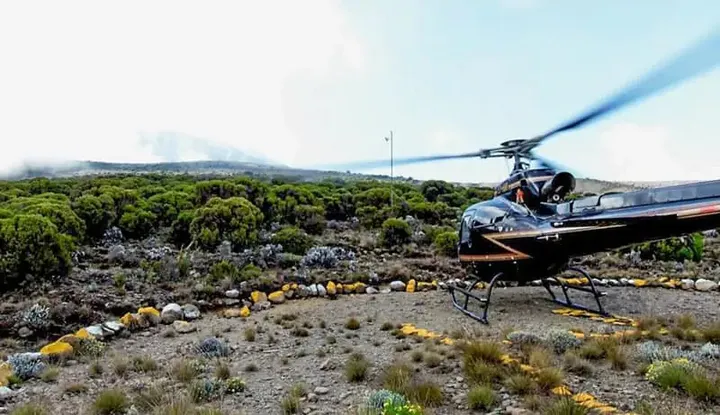
Critical Emergencies During Kilimanjaro Climbs
Certain conditions demand emergency helicopter intervention:
- Severe altitude illness. Progression to High Altitude Pulmonary Edema (HAPE) or Cerebral Edema (HACE)—life-threatening without rapid descent.
- Traumatic injuries. Falls on steep scree slopes, Barranco Wall, or summit ice fields resulting in fractures, head trauma, or immobility.
- Cardiac events. Heart attacks or arrhythmias triggered by exertion and low oxygen.
- Neurological crises. Strokes, seizures, or sudden confusion beyond HACE.
- Extreme exhaustion/hypothermia. Cases where climbers cannot descend independently in cold conditions.
- Summit-day complications. Critical incidents during the final night ascent or crater rim traverse.
These scenarios share time sensitivity—emergency helicopter provides the necessary speed and medical support.
Technical Challenges of Emergency Helicopter Operations
Kilimanjaro presents unique aviation demands:
- Extreme altitude performance. Reduced air density at 5,000+ meters limits lift and engine power.
- Limited landing zones. Few flat areas require hover extractions or short-field precision.
- Weather volatility. Rapid cloud formation, high winds, and whiteouts demand expert judgment.
- Weight constraints. Lightweight medical configuration essential for performance.
- Night operations. Common for summit-day emergencies requiring NVG capability.
Only specialized helicopters and highly trained pilots can consistently overcome these obstacles.
Emergency Helicopter Capabilities
Professional services optimize for climb emergencies:
- High-performance aircraft. Airbus H125 and Bell 407 models proven at extreme altitude.
- Full medical interiors. Stretchers, oxygen systems, monitors, defibrillators, and medications.
- Rescue hoist. Essential for inaccessible locations without landing sites.
- In-flight critical care. Paramedics delivering advanced treatment en route.
- Rapid deployment. 24/7 readiness with strategic forward basing.
KiliFlying Air maintains these capabilities at the highest standard.
Emergency Helicopter Response Procedure
Activation follows refined protocols:
- Guide recognizes emergency and provides initial stabilization
- Radio/satellite alert with GPS coordinates and patient status
- Operator coordinates medical advisory and insurance authorization
- Emergency helicopter launched immediately upon approval
- On-site assessment, advanced care, and extraction
- Direct flight to appropriate hospital with continuous monitoring
Direct partnerships routinely achieve total response under two hours from alert to hospital.
Route-Specific Emergency Helicopter Considerations
Access varies by trail but remains reliable:
- Machame/Lemosho: Excellent access to Barafu and Kosovo high camps
- Rongai/Northern Circuit: Remote but reachable with precision operations
- Marangu: Hut system enables faster ground support when suitable
- Summit zones: Nearby extraction points for crater rim emergencies
Professional services maintain consistent capability across all routes.
Real-World Impact of Emergency Helicopter Response
Proven interventions demonstrate value:
- Summit-night HACE cases evacuated with full neurological recovery
- Barafu Camp trauma patients airlifted before shock progression
- Cardiac events managed with in-flight defibrillation
- Multiple simultaneous rescues during peak-season weather events
These outcomes highlight emergency helicopter services’ indispensable role in modern Kilimanjaro safety.
Frequently Asked Questions
Emergency helicopter services during Kilimanjaro climbs represent the highest standard of safety response. Climb with professional support ready when needed. Visit our Medical Evacuation page for complete details.