Emergency Helicopter Kilimanjaro: Life-Saving Rapid Response
When a medical crisis strikes on Mount Kilimanjaro, emergency helicopter services are often the only way to save lives. KiliFlying Air provides Tanzania’s most reliable and rapid helicopter response for climbers in distress.
Emergency Helicopter Kilimanjaro: Life-Saving Rapid Response
Every year, over 50,000 adventurers attempt to summit Mount Kilimanjaro. While most succeed safely, a small but significant percentage face serious medical emergencies due to the mountain’s extreme altitude, rugged terrain, and unpredictable weather. In these situations, ground evacuation is often too slow—emergency helicopter services become essential.
KiliFlying Air has established itself as the leading provider of emergency helicopter operations on Kilimanjaro. With a 100% safety record in high-altitude rescues, 24/7 availability, and direct partnerships with international insurers, we deliver the fastest and most professional response possible.
This comprehensive guide covers everything climbers need to know about emergency helicopter services: from common triggers and operational challenges to detailed procedures, fleet capabilities, real-world examples, and essential preparation steps.
When Emergency Helicopter Evacuation Is Required
Not every medical issue requires a helicopter, but certain conditions demand immediate airlift:
- High Altitude Pulmonary Edema (HAPE) – fluid buildup in lungs causing severe breathing difficulty
- High Altitude Cerebral Edema (HACE) – brain swelling leading to confusion and loss of coordination
- Traumatic injuries from falls, rockfall, or slips on ice
- Cardiac events or stroke exacerbated by low oxygen
- Severe hypothermia, frostbite, or dehydration
- Acute appendicitis or other internal medical emergencies
These conditions can deteriorate rapidly above 4,000 meters. Walking descent may take 8–12 hours or longer—time the patient often doesn’t have.
Challenges of Emergency Helicopter Operations on Kilimanjaro
Operating helicopters at extreme altitude is extraordinarily demanding:
- Reduced air density limits lift capacity and engine performance
- Few suitable landing zones above 4,500 meters
- Sudden weather changes: high winds, low clouds, snow storms
- Navigation difficulties in featureless high terrain
- Hypoxia risk to pilots and crew
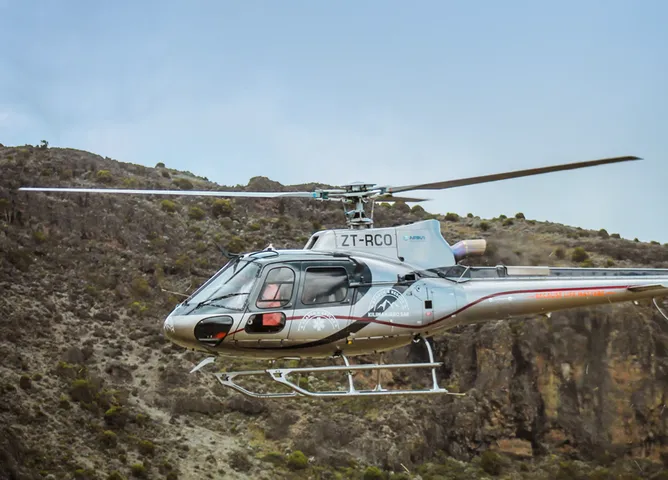
Only specialized aircraft and highly trained pilots can operate reliably in this environment. KiliFlying Air’s team meets the highest international standards for mountain flying.
Our Emergency Helicopter Fleet and Equipment
We maintain a dedicated fleet optimized for Kilimanjaro emergencies:
- Airbus H125 – proven at extreme altitudes worldwide
- Bell 407 – excellent power margin and maneuverability
- Rescue hoist for hover extractions where landing is impossible
- Full medical kit: oxygen, defibrillator, monitors, IV supplies
- Stretcher system with climate control
- Night vision goggles and instrument flight capability
Step-by-Step Emergency Helicopter Procedure
Our process is designed for maximum speed and safety:
- Guide recognizes critical symptoms and initiates alert
- Contact made via radio, satellite phone, or Garmin inReach
- Our 24/7 operations center coordinates with park authorities
- Insurance verification and GOP obtained instantly from partners
- Helicopter scrambled within minutes
- Pilot locates patient using GPS coordinates provided by guide
- Patient stabilized and extracted (landing or hoist)
- Direct flight to hospital in Moshi, Arusha, or Nairobi
Average total time from alert to hospital: under 2 hours.
Real-World Emergency Helicopter Scenarios
Over the years, we’ve responded to hundreds of emergencies:
- A climber at Crater Camp suffering HACE – evacuated in 45 minutes
- Broken ankle at Barafu Camp – hoist extraction due to no landing zone
- Heart attack near Stella Point – rapid descent saved the patient’s life
- Severe HAPE on summit day – evacuated directly to cardiac facility
These cases highlight why having access to professional emergency helicopter services is crucial.
Insurance and Financial Considerations
Emergency helicopter costs range from $15,000 to over $50,000. Comprehensive insurance with high-altitude evacuation coverage is mandatory with reputable operators. We partner with Global Rescue, Allianz, World Nomads, and others for direct billing.
How to Prepare for Emergencies
- Choose operators partnered with reliable air rescue services
- Carry a personal locator beacon or satellite communicator
- Share your insurance details with your guide before the climb
- Acclimatize properly on longer routes
- Listen to your body and report symptoms early
Frequently Asked Questions
Your safety on Kilimanjaro depends on preparation and access to professional emergency helicopter services. KiliFlying Air stands ready 24/7. Explore our Medical Evacuation services or contact us for pre-climb consultations.